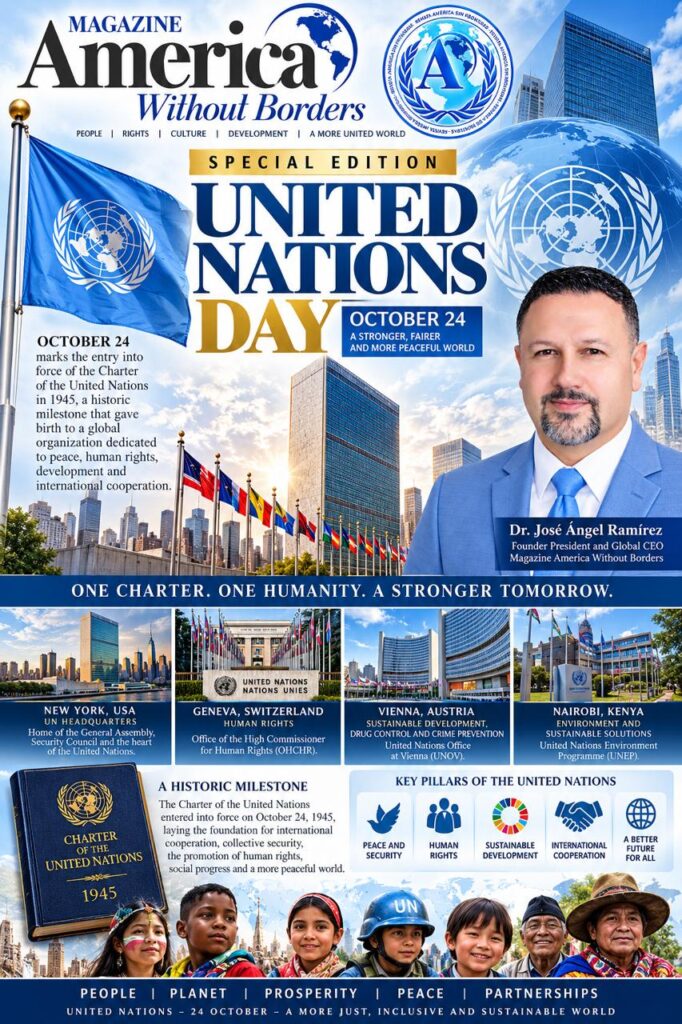
UNITED NATIONS DAY 2026
81 YEARS OF HISTORY, PEACE, HUMAN RIGHTS AND INTERNATIONAL COOPERATION
1945–2026 | A GLOBAL LEGACY AND THE RESPONSIBILITY OF FUTURE GENERATIONS
SPECIAL INTERNATIONAL REPORT OCTOBER 24, 2026
AMÉRICA WITHOUT BORDERS MAGAZINE
People | Human Rights | Culture | Development | International Cooperation
By Dr. José Ángel Ramírez Ramírez
Founder President of América Without Borders Magazine
Global President and Chief Executive Officer of the International Human Rights Commission Global (IHRCG)
Founder President of Corporación Dr. José Ángel Ramírez
“ONE CHARTER. ONE HUMANITY. ONE SHARED RESPONSIBILITY FOR THE FUTURE.”
INTRODUCTION: 81 YEARS OF A UNIVERSAL COMMITMENT TO HUMANITY
UNITED NATIONS HEADQUARTERS, NEW YORK | OCTOBER 24, 2026
On October 24, 2026, the international community commemorates the 81st anniversary of the entry into force of the Charter of the United Nations, one of the most consequential documents in modern diplomatic history.
For more than eight decades, the United Nations has represented humanity’s collective determination to prevent devastating wars, protect fundamental human rights, promote international cooperation and create conditions in which future generations can live with dignity, security and opportunity.
Established in the aftermath of the Second World War, the United Nations emerged from one of the darkest periods in human history.
Its creation was not simply a diplomatic achievement. It was an extraordinary declaration of international responsibility: nations with different political systems, cultures, religions and historical experiences could establish common principles to safeguard humanity.
Today, 81 years later, that commitment remains essential.
Armed conflicts, climate change, forced displacement, poverty, discrimination, food insecurity, technological inequality and humanitarian emergencies continue to challenge the international community.
Yet the central mission of the United Nations endures.
Peace cannot be sustained without justice. Development cannot be meaningful without human dignity. And international cooperation cannot succeed without mutual respect.
Through this special commemorative report, América Without Borders Magazine, under the leadership of Dr. José Ángel Ramírez Ramírez, recognizes the historical contributions of the United Nations while emphasizing the urgent responsibility of governments, international institutions, civil society and citizens to strengthen global solidarity.
⸻
I. THE HISTORICAL ORIGINS OF THE UNITED NATIONS: 1941–1945
The foundations of the United Nations were established during the Second World War, when world leaders began envisioning an international system capable of preventing another global catastrophe.
The process developed through several historic milestones.
1941 — THE ATLANTIC CHARTER
On August 14, 1941, United States President Franklin D. Roosevelt and British Prime Minister Winston Churchill issued the Atlantic Charter.
The declaration articulated principles concerning international security, economic cooperation, self-determination and freedom from fear and want.
Although it did not establish the United Nations, it helped shape the philosophical foundations of the postwar international order.
1942 — THE DECLARATION BY UNITED NATIONS
On January 1, 1942, representatives of 26 Allied nations endorsed the Declaration by United Nations.
The declaration committed its signatories to cooperate against the Axis powers and marked an important early use of the name that would eventually identify the international organization.
1944 — THE DUMBARTON OAKS CONFERENCE
Between August and October 1944, representatives of China, the Soviet Union, the United Kingdom and the United States participated in discussions in Washington, D.C.
These negotiations developed proposals for the structure and responsibilities of a new international organization.
1945 — THE SAN FRANCISCO CONFERENCE
From April 25 to June 26, 1945, representatives of 50 countries gathered in San Francisco, California, for the United Nations Conference on International Organization.
The conference produced the Charter of the United Nations.
On June 26, 1945, the Charter was signed by representatives of the participating countries.
Poland, which was unable to participate in the conference, subsequently signed the Charter and became one of the 51 original members.
OCTOBER 24, 1945 — THE BIRTH OF THE UNITED NATIONS
The Charter officially entered into force on October 24, 1945, following ratification by the five permanent members of the Security Council and a majority of the other signatories.
The United Nations was formally established.
A new chapter in international relations had begun.
Its founding principles included maintaining international peace and security, developing friendly relations among nations, promoting human rights and encouraging cooperation in addressing global challenges.
⸻
II. THE UNITED NATIONS CHARTER: A HISTORIC FOUNDATION FOR INTERNATIONAL LAW
The Charter of the United Nations remains the organization’s foundational treaty.
Its preamble begins with a powerful declaration:
“WE THE PEOPLES OF THE UNITED NATIONS”
These words express a fundamental principle: the United Nations exists not only to facilitate relations between governments but also to serve the peoples whose lives are affected by international decisions.
The Charter establishes obligations concerning peaceful relations, sovereign equality, international cooperation and respect for fundamental rights.
It also prohibits the threat or use of force against the territorial integrity or political independence of states, subject to the framework established by the Charter.
Its principles have shaped international law, diplomacy, peacekeeping, humanitarian assistance and international institutions for generations.
Nevertheless, the history of the United Nations also demonstrates that international agreements require political will, institutional accountability and effective implementation.
A charter can establish principles, but humanity must transform those principles into reality.
⸻
III. 1948: THE UNIVERSAL DECLARATION OF HUMAN RIGHTS
One of the most significant achievements associated with the United Nations occurred on December 10, 1948.
On that date, the United Nations General Assembly adopted the Universal Declaration of Human Rights in Paris, France.
The declaration established a common international standard recognizing the inherent dignity and equal rights of every human being.
Its 30 articles address fundamental freedoms and protections, including the rights to life, liberty, equality before the law, education, freedom of expression, freedom of religion and participation in public affairs.
The declaration also rejects slavery, torture and arbitrary detention.
Although it is not itself a binding treaty, the Universal Declaration has profoundly influenced national constitutions, international conventions and human rights legislation.
It helped establish the foundation for subsequent international human rights instruments, including the International Covenant on Civil and Political Rights and the International Covenant on Economic, Social and Cultural Rights.
For América Without Borders Magazine and the International Human Rights Commission Global, the historical significance of this declaration reinforces a universal conviction:
Human dignity does not depend on nationality, ethnicity, religion, economic status, political identity or geographical borders.
Human rights belong to every person.
⸻
IV. FROM 51 FOUNDING MEMBERS TO 193 MEMBER STATES
The United Nations began in 1945 with 51 founding member states.
Over the following decades, its membership expanded significantly as countries gained independence and entered the international community.
The process of decolonization transformed the political geography of the world and broadened representation within the organization.
In 1960, the General Assembly adopted the Declaration on the Granting of Independence to Colonial Countries and Peoples, an important milestone in the international movement toward self-determination.
The United Nations currently comprises 193 member states, reflecting its nearly universal membership.
South Sudan became the organization’s 193rd member in July 2011.
This expansion illustrates the transformation of the United Nations from a postwar diplomatic institution into a global forum representing countries across every inhabited continent.
Despite their differences, member states share a common responsibility to address challenges that cannot be resolved through isolated national action.
⸻
V. THE SIX PRINCIPAL ORGANS OF THE UNITED NATIONS
The United Nations operates through six principal organs established by its Charter.
- The General Assembly
The General Assembly provides a forum in which all 193 member states participate in discussions concerning international issues.
Each member state has one vote.
- The Security Council
The Security Council carries primary responsibility for the maintenance of international peace and security.
It comprises 15 members, including five permanent members: China, France, Russia, the United Kingdom and the United States.
- The Economic and Social Council (ECOSOC)
ECOSOC coordinates and promotes international cooperation on economic, social and sustainable development matters.
It also provides important mechanisms for engagement with civil society organizations through consultative arrangements.
- The International Court of Justice
Located in The Hague, Netherlands, the International Court of Justice is the principal judicial organ of the United Nations.
It resolves legal disputes submitted by states and provides advisory opinions on legal questions referred by authorized United Nations bodies and agencies.
- The Secretariat
The Secretariat carries out the organization’s daily work and supports its diplomatic, humanitarian, administrative and operational activities.
It is headed by the Secretary-General.
- The Trusteeship Council
The Trusteeship Council was established to supervise the administration of trust territories.
Following the completion of its principal historical mandate, it suspended regular operations in 1994.
Together, these institutions form the constitutional framework of the United Nations.
⸻
VI. THE UNITED NATIONS ACROSS THE WORLD: FOUR MAJOR INTERNATIONAL CENTERS
The United Nations maintains a global institutional presence, with four major duty stations playing particularly important roles.
NEW YORK, UNITED STATES
The diplomatic and political center of the United Nations.
New York hosts the United Nations Headquarters, including the General Assembly and Security Council.
It serves as a principal location for international negotiations, diplomatic meetings and major global initiatives.
GENEVA, SWITZERLAND
A global center for human rights, humanitarian affairs and international diplomacy.
The United Nations Office at Geneva hosts major international meetings and supports the work of numerous organizations and human rights mechanisms.
Geneva is also home to the Office of the United Nations High Commissioner for Human Rights.
VIENNA, AUSTRIA
International cooperation, security, crime prevention and sustainable development.
The United Nations Office at Vienna supports important international activities.
Vienna is associated with the United Nations Office on Drugs and Crime and other institutions addressing global challenges.
NAIROBI, KENYA
Environmental protection, sustainable urban development and international cooperation.
The United Nations Office at Nairobi represents a major institutional center for United Nations activities in Africa.
It hosts the United Nations Environment Programme and UN-Habitat.
These four centers demonstrate the geographical reach and institutional diversity of the United Nations.
⸻
VII. UNITED NATIONS PEACEKEEPING: PROTECTING COMMUNITIES IN TIMES OF CONFLICT
Since 1948, United Nations peacekeeping operations have played an important role in international efforts to manage conflicts and support peace processes.
Peacekeepers have served in different regions under mandates established by the Security Council.
Their responsibilities may include monitoring ceasefires, protecting civilians, supporting political processes, facilitating humanitarian assistance and strengthening national institutions.
United Nations peacekeeping has also faced serious challenges, including situations in which missions were unable to prevent mass atrocities or adequately protect vulnerable populations.
These failures have generated demands for stronger mandates, better resources, greater accountability and more effective international responses.
Peacekeeping remains an important instrument, but it cannot replace sustainable political agreements.
Lasting peace requires more than the absence of war. It requires justice, functioning institutions, economic opportunity and respect for human rights.
⸻
VIII. GLOBAL HEALTH, EDUCATION AND HUMANITARIAN DEVELOPMENT
The United Nations system has contributed to international cooperation across numerous areas of human development.
Through specialized agencies, funds and programmes, it supports efforts to improve public health, education, food security, child protection, refugee assistance and economic opportunity.
Among the most recognized institutions are:
- World Health Organization (WHO): International public health cooperation and disease prevention.
- UNICEF: Protection of children’s rights and support for their health, education and well-being.
- UNESCO: Education, science, culture and preservation of cultural heritage.
- World Food Programme (WFP): Emergency food assistance and efforts to combat hunger.
- United Nations High Commissioner for Refugees (UNHCR): Protection and assistance for refugees and other displaced populations.
- United Nations Development Programme (UNDP): Poverty reduction, governance and sustainable human development.
- Food and Agriculture Organization (FAO): Food security, agriculture and the fight against hunger.
These organizations demonstrate that international peace and human development are deeply interconnected.
A world affected by hunger, exclusion, preventable disease and educational inequality cannot achieve lasting stability.
⸻
IX. 2015–2030: THE SUSTAINABLE DEVELOPMENT GOALS
In September 2015, United Nations member states adopted the 2030 Agenda for Sustainable Development.
The agenda established 17 Sustainable Development Goals, commonly known as the SDGs.
These goals address poverty, hunger, health, education, gender equality, clean water, energy, decent work, infrastructure, inequality, sustainable cities, climate action, environmental protection, peace and global partnerships.
The 2030 Agenda recognizes that development must be inclusive, environmentally responsible and economically sustainable.
Its central commitment is to leave no one behind.
As the world approaches the 2030 deadline, progress remains uneven.
Conflicts, climate emergencies, economic pressures, debt burdens and unequal access to resources continue to obstruct progress in many countries.
The international community must therefore strengthen implementation, financing, cooperation and institutional accountability.
Sustainable development must move beyond declarations and become a measurable improvement in people’s daily lives.
⸻
X. THE UNITED NATIONS AND THE CHALLENGES OF THE 21ST CENTURY
The 81st anniversary of the United Nations arrives at a critical historical moment.
The international community faces complex challenges that require coordinated action.
ARMED CONFLICTS AND INTERNATIONAL SECURITY
Ongoing conflicts and geopolitical tensions continue to threaten civilian populations, regional stability and international peace.
The protection of civilians and respect for international humanitarian law must remain priorities.
CLIMATE CHANGE
Rising temperatures, extreme weather events, water scarcity, biodiversity loss and environmental degradation threaten human security and sustainable development.
International climate cooperation is essential to protecting future generations.
MIGRATION AND FORCED DISPLACEMENT
Millions of people worldwide face displacement associated with conflict, persecution, insecurity, disasters and other crises.
Migration policies must respect human dignity, national legal frameworks and applicable international obligations.
POVERTY AND SOCIAL INEQUALITY
Economic growth alone does not guarantee equitable development.
Governments must strengthen access to education, health care, decent employment, housing and essential services.
ARTIFICIAL INTELLIGENCE AND DIGITAL TRANSFORMATION
Emerging technologies present extraordinary opportunities alongside serious risks.
International cooperation is increasingly necessary to address digital inequality, privacy, misinformation, cybersecurity and the responsible development of artificial intelligence.
INTERNATIONAL INSTITUTIONAL REFORM
The United Nations must continue examining how to strengthen its effectiveness, legitimacy, representativeness and capacity to respond to emergencies.
Constructive reform is essential to preserving international confidence.
⸻
XI. LATIN AMERICA AND THE CARIBBEAN: A REGION OF STRATEGIC IMPORTANCE
Latin America and the Caribbean have played important roles in the development of international diplomacy, human rights frameworks, multilateral cooperation and peaceful conflict resolution.
Countries throughout the region have contributed to the United Nations through diplomatic initiatives, peacekeeping participation, international legal instruments and sustainable development programmes.
Nevertheless, the region continues to face structural challenges involving poverty, inequality, migration, organized violence, environmental vulnerability and access to justice.
For Mexico and the wider American continent, international cooperation represents an opportunity to strengthen education, infrastructure, environmental protection, human rights and economic development.
Border cities such as Tijuana demonstrate the importance of international dialogue.
Their social, economic and cultural connections transcend national boundaries.
The future of these communities depends on constructive cooperation among governments, institutions, businesses and civil society.
Borders define national jurisdictions, but they must never diminish the universal dignity of human beings.
⸻
XII. CIVIL SOCIETY: AN ESSENTIAL PARTNER IN GLOBAL DEVELOPMENT
The United Nations system recognizes the importance of civil society participation in addressing international challenges.
Non-governmental organizations, educational institutions, humanitarian networks, professional associations and independent media contribute to public awareness, research, advocacy and community development.
These contributions are especially valuable in areas involving human rights, education, migration, environmental protection and social inclusion.
However, meaningful cooperation requires transparency, professional integrity, institutional independence and respect for international standards.
International organizations and civil society must work toward common objectives while maintaining clear responsibilities and accountability.
América Without Borders Magazine recognizes journalism and public communication as instruments for encouraging informed dialogue and constructive participation.
The mission of responsible international journalism is not merely to report crises.
It is also to examine their causes, present credible information, highlight solutions and encourage societies to build a more equitable future.
⸻
XIII. AN INSTITUTIONAL MESSAGE FROM DR. JOSÉ ÁNGEL RAMÍREZ RAMÍREZ
Founder President of América Without Borders Magazine
Global President and CEO of the International Human Rights Commission Global (IHRCG)
Founder President of Corporación Dr. José Ángel Ramírez
On the occasion of United Nations Day 2026, Dr. José Ángel Ramírez Ramírez presents the following institutional message:
“HUMANITY MUST BE GREATER THAN OUR DIFFERENCES.”
Eighty-one years ago, the international community established an organization founded upon the hope that dialogue could prevail over destruction, cooperation over division, and human dignity over injustice.
Today, the United Nations continues to symbolize an extraordinary responsibility shared by every nation and every generation.
We must understand that peace cannot be achieved through speeches alone. It requires commitment, education, justice, mutual respect and concrete action.
Governments must recognize that their greatest responsibility is to serve their people.
International institutions must strengthen their capacity to respond to humanitarian challenges.
Civil society must participate responsibly in building solutions.
And the international media must promote truthful information, constructive dialogue and respect for human dignity.
Our world does not need more unnecessary divisions. It needs greater cooperation.
It does not need more indifference toward human suffering. It needs solidarity.
It does not need promises without results. It needs leadership capable of transforming commitments into meaningful achievements.
Through América Without Borders Magazine, the International Human Rights Commission Global and Corporación Dr. José Ángel Ramírez, we reaffirm our institutional commitment to promoting human dignity, international understanding, education, humanitarian values and constructive cooperation.
We recognize the historical contributions of the United Nations while encouraging continued improvement, accountability and institutional reform.
We believe that every child deserves education, every family deserves security, every community deserves opportunities and every human being deserves respect.
The future of humanity must not be determined exclusively by political differences, economic interests or geographical divisions.
It must be guided by our shared responsibility to protect life, promote justice and preserve peace.
The United Nations belongs to the history of humanity. Its future depends on the commitment of humanity.
Let us transform international cooperation into lasting progress.
Let us build bridges where others see barriers.
Let us defend human dignity wherever it is threatened.
And let us remember that the greatest legacy we can leave future generations is not a world without differences, but a world capable of resolving those differences peacefully.
One humanity. One shared planet. One collective responsibility.
Together, we can build a more peaceful, just and sustainable world.
Dr. José Ángel Ramírez Ramírez
XIV. 1945–2026: A HISTORICAL TIMELINE OF THE UNITED NATIONS
Year
Historical milestone
1941
The Atlantic Charter outlines principles for a postwar international order.
1942
The Declaration by United Nations is signed by 26 Allied countries.
1945
The United Nations Charter is signed in San Francisco on June 26.
1945
The United Nations officially comes into existence on October 24.
1946
The first session of the United Nations General Assembly takes place in London.
1948
The Universal Declaration of Human Rights is adopted on December 10.
1948
The first United Nations peacekeeping operation begins.
1950
The Office of the United Nations High Commissioner for Refugees is established.
1960
The General Assembly adopts a landmark declaration on decolonization.
1966
Two major international human rights covenants are adopted.
1972
The United Nations Environment Programme is established.
1979
The Convention on the Elimination of All Forms of Discrimination against Women is adopted.
1989
The Convention on the Rights of the Child is adopted.
1992
The United Nations Conference on Environment and Development takes place in Rio de Janeiro.
1993
The Office of the United Nations High Commissioner for Human Rights is established.
2000
The Millennium Declaration is adopted.
2006
The United Nations Human Rights Council is established.
2011
South Sudan becomes the 193rd United Nations member state.
2015
The 2030 Agenda and its 17 Sustainable Development Goals are adopted.
2020
The United Nations commemorates its 75th anniversary amid the COVID-19 pandemic.
2024
The Summit of the Future adopts the Pact for the Future.
2025
The United Nations commemorates 80 years since its founding.
2026
The international community marks 81 years of the United Nations and renews attention to peace, development and global cooperation.
XV. THE FUTURE OF THE UNITED NATIONS: FROM HISTORICAL ACHIEVEMENTS TO GLOBAL RESPONSIBILITY
The 81st anniversary of the United Nations must be more than a ceremonial commemoration.
It should represent an opportunity for critical reflection and renewed international commitment.
The United Nations has contributed to the development of international law, the protection of human rights, humanitarian assistance, public health cooperation, sustainable development and diplomatic dialogue.
At the same time, its history includes failures, institutional limitations and unresolved challenges.
Acknowledging these realities does not diminish the importance of the organization.
It strengthens the case for meaningful reform.
The world of 2026 is fundamentally different from the world of 1945.
Technology has transformed communication.
Globalization has deepened economic interdependence.
Environmental crises have demonstrated the vulnerability of shared ecosystems.
And modern humanitarian emergencies have revealed how closely connected the destinies of nations have become.
No country, regardless of its economic strength, military capacity or political influence, can independently resolve every challenge facing humanity.
The United Nations therefore remains an essential international forum.
Its continued relevance will depend on its ability to adapt, strengthen accountability, improve institutional effectiveness and translate international commitments into measurable results.
FINAL EDITORIAL DECLARATION
UNITED NATIONS DAY 2026
81 YEARS OF HISTORY. ONE HUMANITY. A SHARED FUTURE.
NEW YORK | GENEVA | VIENNA | NAIROBI | THE WORLD
On October 24, 2026, América Without Borders Magazine joins the international commemoration of the 81st anniversary of the United Nations.
We recognize the importance of the United Nations Charter, the Universal Declaration of Human Rights, international humanitarian cooperation and the pursuit of sustainable development.
We also recognize that the work remains unfinished.
There can be no genuine international progress while millions of people continue to experience violence, hunger, discrimination, displacement and exclusion.
The responsibility of the present generation is to transform the lessons of history into practical commitments for the future.
The United Nations was established in response to the devastation of global conflict.
Its enduring purpose is to help humanity prevent the repetition of such tragedies.
The greatest tribute to the founders of the United Nations is not simply to remember what they created in 1945, but to strengthen the principles they entrusted to future generations.
May this 81st anniversary inspire governments, international organizations, educational institutions, humanitarian networks and citizens throughout the world to pursue cooperation over confrontation, justice over indifference and human dignity over division.
PEACE IS OUR RESPONSIBILITY.
HUMAN RIGHTS ARE OUR FOUNDATION.
INTERNATIONAL COOPERATION IS OUR STRENGTH.
THE FUTURE OF HUMANITY IS OUR SHARED COMMITMENT.
SPECIAL INTERNATIONAL COMMEMORATIVE EDITION
AMÉRICA WITHOUT BORDERS MAGAZINE
Dr. José Ángel Ramírez Ramírez
Founder President — América Without Borders Magazine
Global President & Chief Executive Officer — International Human Rights Commission Global (IHRCG)
Founder President — Corporación Dr. José Ángel Ramírez
October 24, 2026
Historical reference framework: Charter of the United Nations; United Nations institutional history; Universal Declaration of Human Rights; United Nations peacekeeping history; United Nations 2030 Agenda for Sustainable Development.
Editorial note: This commemorative publication is an independent institutional editorial initiative. It does not imply official United Nations endorsement, affiliation or authorization.
“ONE CHARTER. ONE HUMANITY. ONE STRONGER TOMORROW.”
UNITED NATIONS DAY | 24 OCTOBER 2026
81 YEARS OF COMMITMENT TO PEACE, HUMAN DIGNITY AND GLOBAL SOLIDARITY.
